Epicheiro Sterea: grant of up to 75% for SMEs in Central Greece
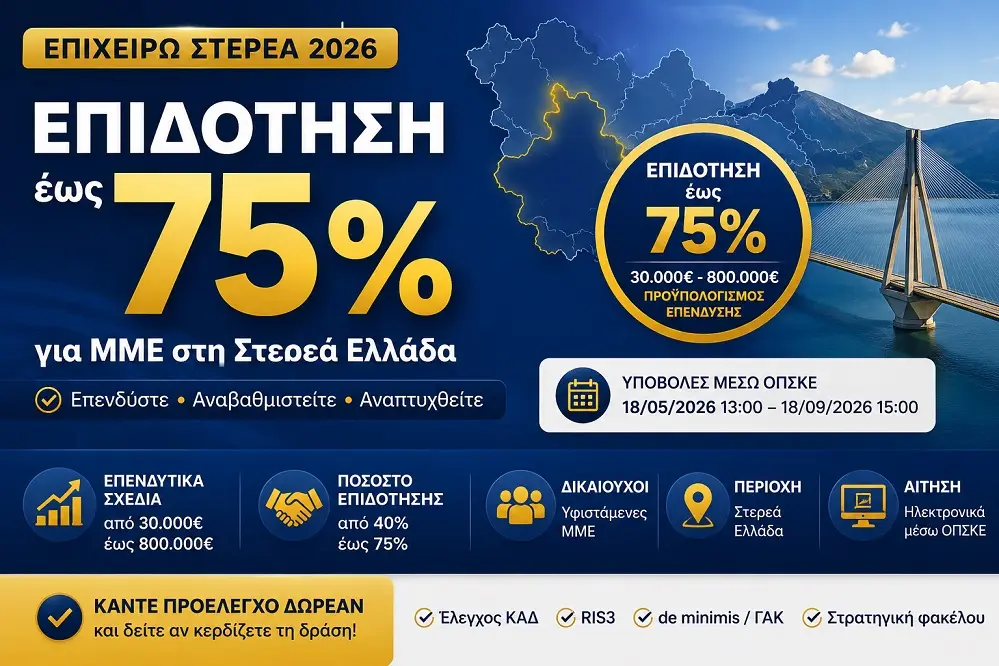
⚡ Last updated 04/07/2026 · Includes the 1st Amendment · Submissions through OPSKEEpicheiro Sterea 2026 provides a grant of up to 75% to existing SMEs in Central Greece, for investment plans ranging from €30,000 to €800,000. Applications are submitted through OPSKE, and success depends on having the correct KAD (activity code), RIS3 alignment, own contribution, and a strong evaluation file.
The programme does not require merely filling in an application. It requires strategic preparation: the correct aid scheme, the correct KAD (activity code), proper alignment with RIS3 sectors, clearly defined expenses, and a file capable of succeeding in the comparative evaluation.
What is Epicheiro Sterea 2026
Epicheiro Sterea 2026 is an ESPA 2021–2027 action supporting existing micro, small, and medium-sized enterprises in the Region of Central Greece.
The action funds investment plans that improve competitiveness, production modernisation, the green transition, digital upgrading, and the company’s connection with smart-specialisation sectors.
The official action is the programme “Epicheiro Sterea” on the ESPA portal, with electronic submission through OPSKE.
How the grant reaches up to 75%
The up to 75% rate is the action’s key advantage. Choosing the right aid scheme and the right mix of expenses determines how high the grant rate can reach.

Under de minimis, the maximum 75% rate can be used when the investment plan is structured as a green project, with meaningful green expenses linked to energy upgrading, savings, or environmental improvement.
The highest rate can be achieved when the investment plan has the right structure, a clear aid rationale, and expenses genuinely connected to upgrading the business.
Choosing de minimis or the GBER is not merely a formal selection in OPSKE. It affects the size of the investment plan, the grant rate, the expense structure, and how the Business Plan must be documented.
What is funded under Epicheiro Sterea 2026
Under Epicheiro Sterea 2026, expenses related to business upgrading, modernisation, the green transition, digital improvement, and growth are funded.
Selecting the right expenses is critical. It is not enough for an expense to appear in the guide. It must align with the KAD, aid scheme, own contribution, Business Plan, and overall OPSKE application strategy.
Full payroll cost of newly hired personnel, where provided under the action’s terms.
Other equipment, laboratory or quality-control equipment, digital office equipment, production equipment, and mechanical equipment.
Equipment for environmental protection, energy saving, the circular economy, photovoltaic systems, and storage systems for self-generation.
Electric means of transport, where linked to the needs and operation of the investment plan.
Building works, facilities, surrounding areas, and interventions for saving energy or water, or for waste treatment.
Consulting support, technical studies, product or process development studies, know-how, intellectual property, and patents.
Software, licences, SaaS, cloud computing, and related digital services supporting the investment.
Packaging and label design, branding, participation in trade fairs, publicity, promotion, and networking.
A strong investment plan is not a shopping list. It is a carefully designed combination of expenses showing why the business needs the investment, how it will improve its operations, and how it will lead to sustainable growth and profitability.
Who is eligible and how to build a strong application file
Eligible applicants are existing SMEs operating in Central Greece, established before 30/06/2023, with at least two complete closed financial years, an eligible KAD, and an investment plan linked to RIS3 sectors.
-
1
Correct business profile. The establishment date, size, financial years, and implementation region are checked.
-
2
Correct KAD. The investment KAD must correspond to the actual business activity and the call.
-
3
Correct RIS3 alignment. The plan must fall within an eligible smart-specialisation sector.
-
4
Correct aid scheme. De minimis or GBER is not merely a formal choice; it affects amounts, rates, and the application file.
-
5
Correct documentation. Own contribution, expenses, permits, and business information must all be consistent.
The 8 RIS3 sectors that guide the investment
Alignment with RIS3 is a key strategic point. The investment plan must clearly explain which sector it belongs to and why its expenses support that sector.
For production, construction, industrial upgrading, and technical solutions.
For accommodation, tourism services, destination experiences, and cultural activities.
For food, local products, production, standardisation, and processing.
For resource savings, circular use of resources, and environmental upgrading.
For health, care, life-science, and related service activities.
For logistics, transport, storage, and organised distribution.
For energy upgrading, savings, and sustainable energy solutions.
For software, cloud services, automation, digital equipment, and technological upgrading.
Before applying, it must be verified which smart-specialisation sector the investment plan belongs to and whether the proposed expenses meaningfully document that connection.
Epicheiro Sterea KAD: the second major success factor
The KAD is one of the first points that must be checked. Operating in Central Greece is not enough; the investment KAD, the physical scope of the project, and the expenses must be consistent.
For a more targeted check, see the page Epicheiro Sterea KAD: do you have an eligible KAD for a grant of up to 75%?.
Why accommodation businesses require special handling
Accommodation businesses, guesthouses, and tourism enterprises show very strong interest in Epicheiro Sterea, but they should not be handled with generic copy. They require a separate review of KAD 55, capacity, category, and investment objective.
Especially where the project concerns upgrading or increasing accommodation capacity, the review must determine whether category requirements such as 4 stars, 4 keys, or a minimum capacity apply, depending on the type of investment and KAD.

For an accommodation investment, we do not only check whether there is an eligible KAD. We examine whether the project delivers an upgrade, meets category requirements, aligns with tourism/RIS3, and whether the expenses can support a high aid rate.
See also the page Epicheiro Sterea for tourist accommodation: grant of up to 75% in tourism.
Comparative evaluation: eligibility alone is not enough
The action is evaluated comparatively. This means the application file must not merely pass the formal eligibility check; it must be strong enough to compete in the ranking.
Business Plan / Feasibility Study: the basis for a strong and successful application file
Under Epicheiro Sterea 2026, the Business Plan is not a routine supporting document. It is the core of the application file. It must show why the investment makes economic sense, how the expenses will be used, how sustainability will be supported, and why the project deserves funding.
The call’s supporting material includes a dedicated file on Feasibility Study Contents and an IRR calculation template. This shows that a description alone is not sufficient for larger and more demanding investment plans. Documentation of feasibility, cost, financing, sustainability, and return on investment is required.
MegaProfit prepares the investment’s Business Plan / Feasibility Study, ensuring that the KAD, eligible expenses, aid scheme, own contribution, and business objectives form a clear and competitive application file.
An application does not succeed simply because it has an eligible KAD. It succeeds when it presents a carefully designed investment plan with clear documentation, financial consistency, sustainability, and profitability prospects.
What changes were introduced by the 1st Amendment
The action has a published 1st Amendment. Therefore, every preliminary check and application must be based on the latest call documents, not on old summaries or general articles.
Before final submission in OPSKE, the call, the amendment, the FAQs, and any supporting documents issued by the competent authority must be reviewed.
MegaProfit preliminary check: from “am I eligible?” to “how do I succeed?”
A proper preliminary check does not stop at eligibility. It assesses whether the application can be structured competitively, with the correct scheme, the right expenses, clear documentation, and a file that addresses the action’s criteria.
-
1
Business check Financial years, size, region, operating history, and basic requirements.
-
2
KAD and RIS3 check Alignment of the KAD, business scope, RIS3 sector, and investment expenses.
-
3
Grant-rate check Analysis of de minimis or GBER and the possibility of using a higher grant rate.
-
4
Application-file preparation Organisation of documentation, expenses, own contribution, and business rationale.

Frequently asked questions about Epicheiro Sterea 2026
What is Epicheiro Sterea 2026?
It is an ESPA 2021–2027 action for existing micro, small, and medium-sized enterprises in the Region of Central Greece.
How much is the Epicheiro Sterea grant?
The grant reaches up to 75%. Under de minimis, the rates are 70%–75%, while under the GBER they range from 40%–60%.
When are applications submitted?
Applications are submitted electronically through OPSKE from 18/05/2026 at 13:00 until 18/09/2026 at 15:00.
What is the investment budget?
For de minimis, the eligible budget is €30,000–€400,000, while for the GBER it is €200,000–€800,000.
What expenses are funded under Epicheiro Sterea 2026?
Indicatively, funded expenses include personnel, equipment, green and energy interventions, buildings and facilities, software, cloud services, studies, branding, promotion, participation in exhibitions, and indirect expenses, subject to the terms of the selected aid scheme.
Is it enough for an expense to appear in the guide for it to be included in the application?
No. The expense must be linked to the KAD, the physical scope, the aid scheme, the investment objective, and the Business Plan. A strong application file is not a simple shopping list, but a carefully designed investment plan.
Why is the Business Plan critical under Epicheiro Sterea?
The Business Plan is the core of the application file. It shows why the investment makes economic sense, how the expenses will be used, how the own contribution will be supported, and how the business can achieve sustainability, growth, and profitability.
Does MegaProfit prepare Business Plans for Epicheiro Sterea?
Yes. MegaProfit undertakes the study and preparation of the investment Business Plan, linking the KAD, eligible expenses, de minimis or GBER, own contribution, sustainability, profitability, and application strategy for submission through OPSKE.
Is the consultant’s fee eligible under Epicheiro Sterea 2026?
Eligible expenses under the action include consulting support for monitoring implementation of the investment plan, subject to the terms of the call. Preparation, study, and application strategy must be considered separately so that the consultant’s commercial service is not confused with an eligible implementation expense.
Why is a carefully prepared Business Plan needed instead of a simple list of expenses?
Because the application file must show how the expenses relate to the KAD, aid scheme, own contribution, sustainability, and profitability of the investment. A carefully prepared Business Plan explains why the investment makes economic sense and deserves funding.
Are two closed financial years required?
Yes. The business must be existing, must have been established before 30/06/2023, and must have at least two complete closed financial years.
Why is a preliminary check needed before applying?
Because the KAD, RIS3 alignment, aid scheme, own contribution, expenses, and basic application strategy must be checked before submission through OPSKE.
Author, fact-checking, and disclosure
Panagiotis Grafakos, Economist, Class A Accountant, Business & Investment Consultant. Economic Chamber of Greece Registration No.: 9911097875. He has more than 30 years of experience in grants, business plans, and ESPA / LEADER / DYPA programmes.
The content was checked against information from EFEPAE, ESPA, the Region of Central Greece, and OPSKE. Last updated / last reviewed: 04/07/2026.
MegaProfit is not a public authority and does not replace OPSKE, EFEPAE, or the Region of Central Greece. It provides consulting support, preliminary checks, and application-file preparation for businesses seeking funding under the action.